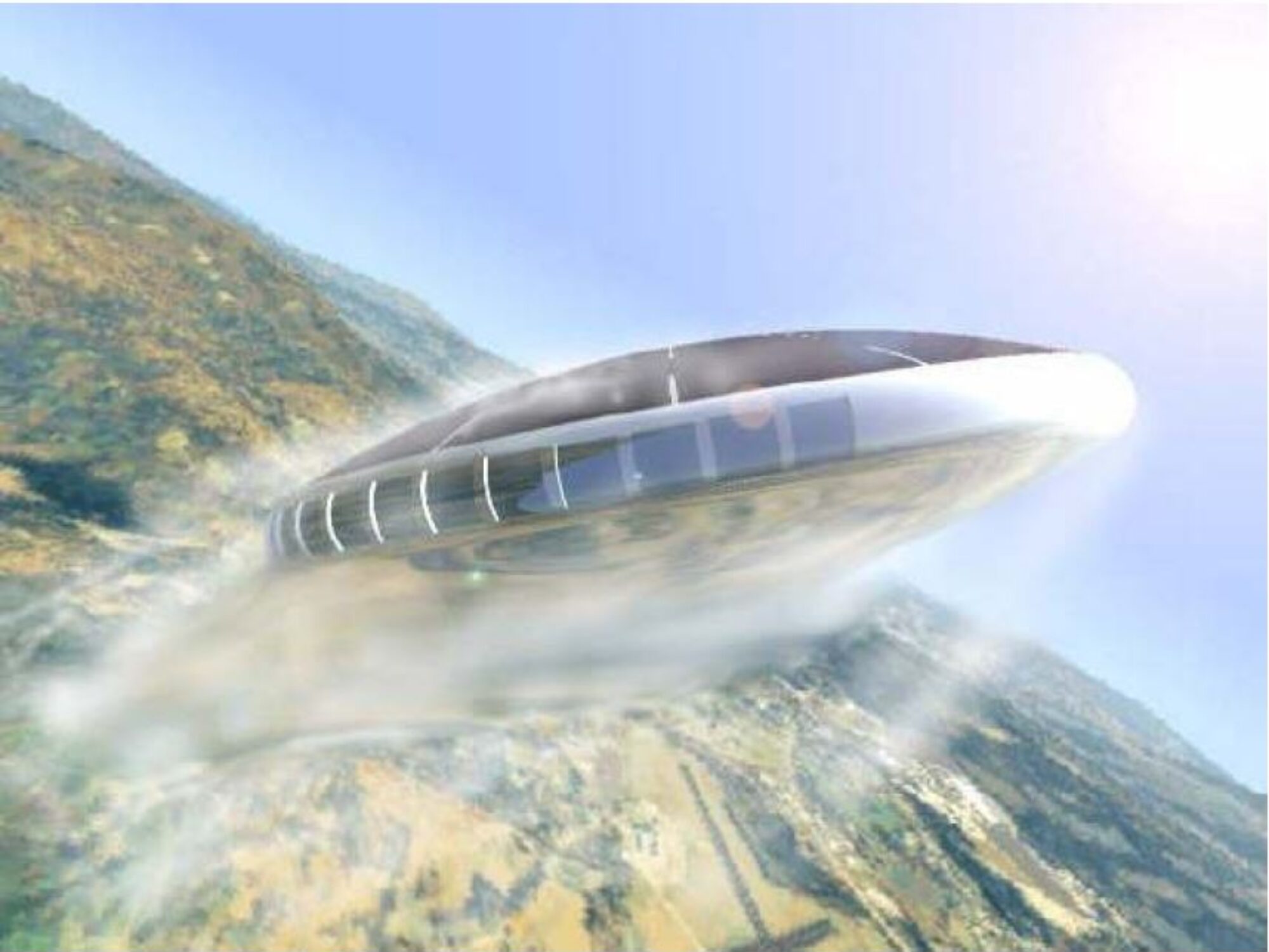

Did the famous Aguadilla UFO enter the ocean and split in two? The infrared footage recorded near Puerto Rico on 26 April 2013 appears to show unusual motion. The official AARO assessment released on 20 March 2025 offers a different explanation: ordinary motion can appear extraordinary when viewed from a moving aircraft through an infrared sensor.
What did the official investigation find?
AARO reconstructed the observation geometry and estimated the targets’ altitude at approximately 200 metres and their ground speed at 3.6 metres per second, comparable to the measured wind speed of 4.4 metres per second. It concluded with high confidence that two nearby objects were present and that their reconstructed trajectories remained over land. It identified sky lanterns as a possible explanation with moderate, not absolute, confidence.
Why apparent speed is not true speed
Consider looking sideways from a moving car: a nearby fence appears to sweep past more rapidly than a distant mountain. The difference arises from viewing geometry. In an airborne infrared recording, camera tracking, zoom and observer motion add further complications. Estimating a target’s speed requires a reference frame and a defensible range estimate.
For an illustrative calculation, suppose a stationary target is observed at the closest point of a straight observer path, with a perpendicular separation of 500 m. If the observer travels at 50 m/s, the instantaneous angular rate is 0.1 rad/s (about 5.7 degrees per second). The target’s ground speed is still zero. This example is independent of the Aguadilla reconstruction and is not a measurement from the footage.
Can infrared targets disappear without entering water?
An infrared image depends on the difference in detected radiance between a target and its surroundings. Similar apparent radiances can make the target difficult to distinguish. Atmospheric attenuation, limited spatial resolution and changing range can also reduce detectability. Loss of contrast does not establish that an object physically disappeared or crossed the air-water boundary.
Evidence versus interpretation
Three questions need separate answers: whether the recording is authentic, whether the depicted motion is physically unusual, and whether the objects can be positively identified. The AARO assessment addresses the latter two with different confidence levels. Its result is a documented official reconstruction, not an independent replication by this website. Readers should examine the assumptions and compare competing models against the original sensor information.
Official documents and related UFO research
- AARO: Puerto Rico Object case resolution, 20 March 2025 (PDF)
- AARO: official UAP imagery and video archive
- NASA: UAP scientific FAQ
- UFO explained: evidence and definitions
- UFO or Starlink? Satellite flares and observation checklist
Editorial method: public sources only. This article reviews a historical case and a 2025 report; it does not describe a new 2026 sighting.
Compare the Gimbal UFO infrared video analysis for additional context on sensor uncertainty.